Commercial Range Burner Won’t Light? What Restaurant Owners Should Check
When a commercial range burner will not light, the problem can throw off the whole kitchen. Line cooks lose a cooking station, prep gets delayed, and managers have to decide whether the issue is a quick cleaning problem or something that needs a technician.
For restaurants, cafes, markets, and commercial kitchens in Methuen, the Merrimack Valley, and Southern New Hampshire, range problems are more than an inconvenience. A burner that will not light can point to blocked ports, pilot issues, ignition problems, control trouble, or a gas-safety concern that should not be guessed at.
NewGen HVAC / New Generation HVAC LLC is a family-run, bilingual HVAC, refrigeration, and commercial kitchen equipment company based in Methuen, MA. Here is a practical guide to what business owners can check safely and when it is time to schedule commercial kitchen equipment repair.
Start With Safety Before Troubleshooting
If anyone smells gas, hears hissing, feels lightheaded, or suspects a leak, do not keep trying to light the burner. Turn off the equipment if it is safe to do so, leave the area, follow your emergency procedure, and contact the proper utility or emergency service.
For normal no-light issues with no gas odor, staff can make a few basic observations. The goal is not to take apart gas components or bypass safeties. The goal is to gather useful information and avoid making the problem worse.
Useful first questions include:
- Is only one burner affected, or is the whole range down?
- Did the problem start after cleaning, a spill, or heavy service?
- Is the pilot lit where that equipment uses a standing pilot?
- Do nearby appliances have normal gas supply?
- Are knobs, valves, or ignition switches behaving differently than usual?
- Is there soot, yellow flame, delayed ignition, or popping when it does light?
Those details help a technician narrow the diagnosis faster.
Common Reasons a Commercial Range Burner Will Not Light
A burner that will not light does not always mean the range needs replacement. In many cases, the problem is isolated to airflow, ignition, fuel delivery, controls, or cleaning-related buildup.
1. Food debris or grease blocking the burner ports
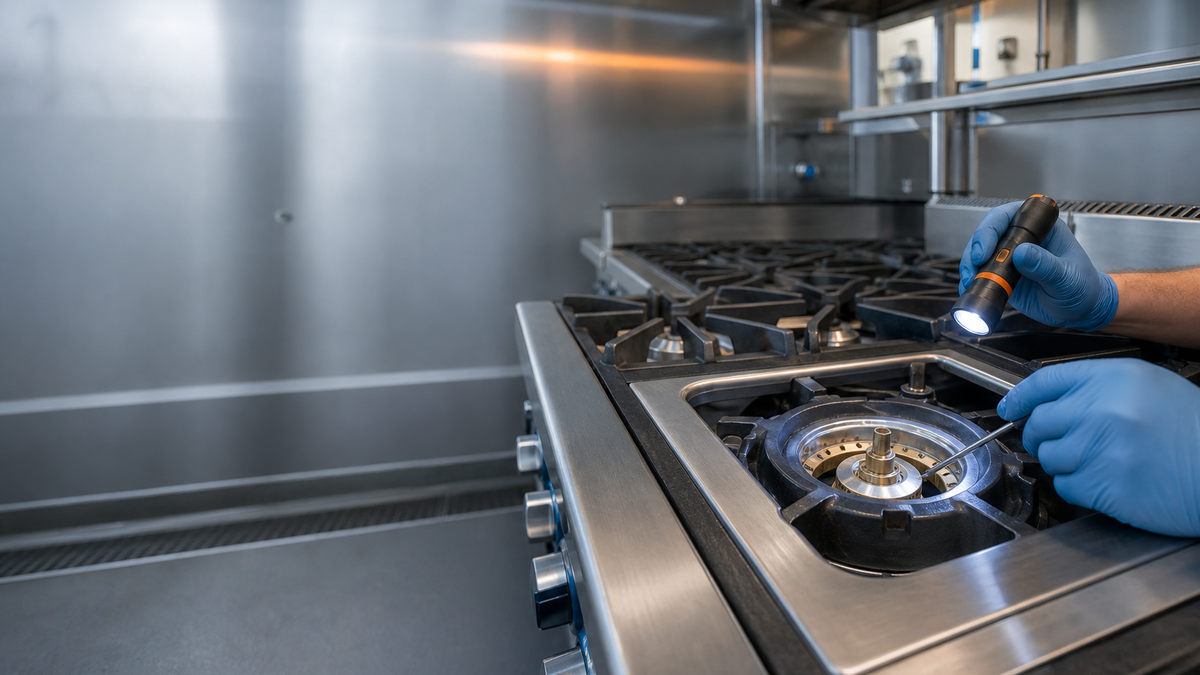
Commercial ranges live in a tough environment. Grease, food particles, boil-overs, flour dust, and cleaning residue can block the small openings where gas and air need to mix. When burner ports are clogged, the flame may be weak, uneven, delayed, or missing in certain areas.
Staff can usually keep visible surfaces clean according to the equipment manual, but avoid using sharp tools that can damage burner openings. If the same burner keeps clogging or the flame pattern stays uneven after normal cleaning, it should be checked.
2. Pilot light problems
Some commercial ranges use standing pilots. If the pilot is out, weak, dirty, or not positioned correctly, the burner may not light reliably. Drafts, spills, dirty pilot assemblies, or gas supply issues can all affect pilot performance.
Relighting should only be done according to the manufacturer’s instructions and your kitchen’s safety procedures. If the pilot will not stay lit, do not keep forcing it. That can point to a thermocouple, thermopile, safety valve, or gas supply issue that needs service.
3. Ignition module or spark problems
Ranges with electronic ignition may click but fail to light, click weakly, click at the wrong burner, or do nothing at all. Moisture from cleaning, damaged wires, cracked electrodes, poor grounding, or a failing ignition module can all cause ignition trouble.
If the range was just cleaned, moisture may be part of the issue. But repeated ignition failure during service should be diagnosed before staff start using workarounds that create safety risks.
4. Knobs, gas valves, or control issues
A burner knob that feels loose, stiff, or different from the others may be more than a nuisance. Behind the knob, the valve and control parts need to operate smoothly and safely. If a valve is not opening correctly, is difficult to turn, or does not seem to match the flame response, the equipment should be inspected.
Do not lubricate, force, or modify gas valves. That is repair work for a qualified technician.
5. Air mixture or flame quality problems
Even if the burner lights, the flame can tell you a lot. A stable blue flame is usually the goal on gas cooking equipment. Yellow flames, lifting flames, soot, popping, or delayed ignition can point to combustion, airflow, burner, or gas pressure issues.
Flame quality matters because it affects cooking performance, equipment cleanliness, and kitchen safety. If flame behavior changes suddenly, schedule service.
6. Gas pressure or supply problems
If multiple burners or multiple appliances are acting up at once, the issue may not be one burner. A regulator problem, shutoff valve position, supply interruption, or broader gas pressure issue can affect the whole line of equipment.
This is not something restaurant staff should guess at. A technician can check the equipment and determine whether the problem is inside the appliance or related to supply conditions.
What Staff Can Check Without Taking the Range Apart
Restaurant staff can help prevent downtime by watching for changes during normal cleaning and opening routines. Safe checks usually include:
- Confirming the affected burner is seated correctly after cleaning, if the equipment design allows removal.
- Keeping visible burner surfaces clean according to the manual.
- Making sure knobs are not cracked, missing, or slipping.
- Checking whether the problem follows one burner or affects the entire range.
- Noting whether ignition clicks, sparks, or stays silent.
- Watching flame color and stability when the burner does light.
- Reporting repeated problems instead of working around them.
What staff should not do: bypass safety controls, adjust internal gas parts, force stuck valves, use open flames in unsafe ways, or keep operating equipment that smells like gas.
Why Burner Problems Cost More Than the Repair Ticket
A down burner changes the flow of a kitchen. One station gets overloaded, ticket times slow down, staff improvise, and peak service becomes harder. If the problem affects a main range, fryer line, oven, or griddle area, the impact can spread quickly.
There is also a safety side. Delayed ignition, poor flame quality, gas odor, and repeated pilot failures should be taken seriously. Waiting too long can turn a manageable repair into a larger equipment problem or an emergency call during dinner service.
When to Call for Commercial Range Repair
Call for service if:
- a burner will not light after basic cleaning and normal startup steps
- the pilot will not stay lit
- ignition keeps clicking without lighting
- flames are yellow, uneven, lifting, or producing soot
- knobs or valves feel loose, stuck, or unsafe
- multiple burners or appliances are affected
- staff smell gas or notice delayed ignition
- the issue is disrupting service or prep
A practical service visit should identify the cause instead of just treating the symptom. Depending on the equipment, that may include checking the burner assembly, pilot, ignition parts, thermocouple or thermopile, controls, valves, gas pressure, and overall equipment condition.
How NewGen HVAC Helps Restaurants and Commercial Kitchens
NewGen HVAC is known locally for HVAC and commercial refrigeration, but the same in-house service approach also matters for commercial kitchen equipment. Restaurants often have overlapping problems: a hot kitchen affects refrigeration, a down range affects service, and HVAC downtime affects staff and customers.
Because NewGen handles residential HVAC, commercial HVAC, commercial refrigeration, and commercial kitchen equipment, business owners can call one local team for practical diagnosis across the systems that keep the building running.
We serve Methuen, Lawrence, Haverhill, Andover, North Andover, Lowell, Tewksbury, Salem NH, Pelham NH, Derry NH, and nearby communities across the Merrimack Valley and Southern New Hampshire.
Need Kitchen Equipment Repair in Methuen or Southern NH?
If a commercial range burner will not light or your kitchen equipment is slowing down service, contact NewGen HVAC for a clear diagnosis and repair options. For equipment problems that cannot wait, 24/7 emergency help is available.
Call (978) 876-8558, email jc@newgenhvac.com, or request service through the contact page. You can also learn more about NewGen HVAC services at /services/ and the local service area at /service-areas/.
FAQ
Why does one commercial range burner fail while the others work?
One burner may have blocked ports, a pilot or ignition issue, a burner alignment problem, or a valve/control issue. If the rest of the range works normally, the problem may be isolated, but it should still be checked if it keeps happening.
Is a yellow flame on a commercial range a problem?
A yellow or sooty flame can point to poor combustion, airflow problems, dirty components, or gas pressure issues. It should not be ignored, especially if the flame pattern changed suddenly.
Should restaurant staff repair a gas burner themselves?
Staff can handle normal cleaning and basic observations according to the equipment manual, but gas valves, pilots, ignition components, regulators, and safety controls should be serviced by a qualified technician.